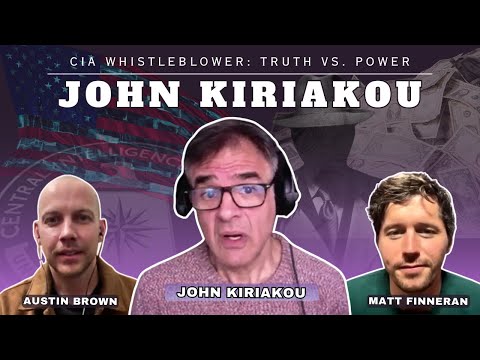
#05 CIA Whistleblower John Kiriakou: The Truth They Tried to Bury 🇺🇸🕵️♂️
About This Episode
He blew the whistle on the CIA—and paid the price. In this explosive interview, John Kiriakou, former CIA officer turned whistleblower, shares what really happens behind the scenes of U.S. intelligence. From exposing the government's use of torture to facing prison time for telling the truth, Kiriakou's story is one the powers-that-be didn't want you to hear. 🎙 Hosted by Austin Brown & Matt Finneran 👉 Watch until the end for a shocking inside look at the CIA’s operations. 📌 Don’t forget to like, comment, and subscribe for more real conversations the mainstream won’t show you. #JohnKiriakou #CIAWhistleblower #ciasecrets #truth #power #governmenttransparency #podcast #espionage #whistleblower #intelligencecommunity #intelligence #humanrights #politics #cia #spy #exposedtruth 00:00 The Morality of Intelligence Work 03:13 Diplomacy and the Role of the CIA 05:56 Understanding the CIA's Structure and Operations 09:05 Funding and Budgeting of the CIA 12:07 The CIA's Relationship with Other Agencies 14:49 The CIA and Cryptocurrencies 18:02 The CIA's Approach to Assassinations and Ethics 20:59 UFOs and Extraterrestrial Speculation 34:31 The Boundaries of Surveillance: CIA vs. NSA 39:02 Encryption and Communication: Trust Issues 45:31 The Complexity of Middle Eastern Politics 49:09 Debunking 9/11 Conspiracy Theories 55:51 The Nature of Power and Intelligence Agencies 01:01:28 Fatherhood and the Stakes of Parenthood 01:04:22 The 9/11 Intelligence Failure 01:05:19 Missed Global Events and CIA's Shortcomings 01:08:31 Balancing Secrecy and Transparency in Intelligence 01:10:20 CIA's Influence on Media and Hollywood 01:16:45 Remote Viewing and CIA's Unconventional Methods 01:20:25 Whistleblowing and Internal Surveillance in the CIA 01:24:41 The JFK Files and Government Secrecy
Full Transcript
My boss came up to me to wish me well. He shook my hand and then he leaned in and he whispered, "Kill them all. They could legally be assassinated. It's going to keep your mouth shut and carry out the mission." The CIA doesn't give a about money laundering. I want you to imagine for a second that your country asks you to fly to the Middle East, befriend people that were on the CIA watch list, capture them, later on find out they're being tortured more than what was being reported, and now you're stuck with a moral moral dilemma. Do you do you blow the whistle? You do blow the whistle, and then you immediately get thrown into jail. This is the story of John Kuryaku, who Matt and I got to interview. We got to ask him a lot of questions that we didn't see asked on shows like the Danny Jones podcast where you might have seen him where he amassed millions of views. He's one of the most interesting men on the face of this planet. He still texts with princes, royalty, politicians of the ilk that most of us will never get a chance to even have contact with. And he took almost a couple of hours to sit down and answer all of our questions. We get to ask him about interesting things like Bitcoin or UFOs or what it's like to raise a family when you're constantly going in and out of war zones. What it's like to keep secrets from your family. I really hope you enjoy this as much as we did. Welcome to the Austin and Matt podcast. Okay, John, I wanted to start off with a question, a high level question. This might be a little difficult. Given everything you know now, would you consider your time you at the CIA, would you consider that as see yourself as a good guy or a bad guy knowing everything that you know in the aftermath? Oh, I I see myself as a good guy. you know, even even when I was still a true believer, um I considered myself to be a good guy because because I I went in I went into the organization with my own sort of um ethical bottom line. There were there were things that I knew to be illegal that I refused to to take part in. And even after the 911 attacks when I went to Pakistan, it was all about, you know, carrying out the mission but doing that within the confines of the law. And I honestly truly cannot name another officer who who carried out their Pakistan assignment with that in mind. Yeah. And you have to and I'm not blaming anybody here, right? You have to remember in the immediate aftermath of 911 there was this incredible almost overwhelming desire for revenge and I got it. I wanted revenge too high school staying the same thing. I remember the feeling the emotion everything welled up. I remember it for for it was a prison for a long time. When I was leaving for Pakistan I uh I went into the office a couple of hours few hours before my flight and uh my boss came up to me to wish me well. shook my hand and then he leaned in and he whispered, "Kill them all." And I said I said, "Really, John?" His name was John as well. I said, "Is that where we are already?" And that bothered me the whole flight over. And then, you know, once I stepped into it, I was like, "No, no, no, no. It's not about killing anybody. It's about bringing them to justice." Well, given that that mentality existed at one point in time, I wonder if it still does. And I wonder if you could comment on Biden recently authorizing the use of our weapons over in Ukraine. What do you Right. So Biden authorized the use of uh of attack of rocket or rockets and in fact you know we're talking on Tuesday the 19th. Uh those rockets were fired for the first time yesterday. Uh this is a significant upgrade. Um attackums we've used attackums for decades. uh when I was in uh when I was serving in Bahrain for example uh we provided attackums to the to the Bahrainis for possible thank god not uh not necessary use against Iran were Iran to invade. So these are very sophisticated very precise highlevel uh missiles that are going to really worsen the situation. I get theoretically why this decision was made. The idea is if there are going to be peace talks, you want to carry out those talks from a position of as as great a strength as you can muster. Uh this isn't to defeat the Russians. The Ukrainians can't defeat the Russians. Russia is a nuclear power. um God forbid if it comes to that, the Russians will do anything that they need to do to to save themselves, to protect themselves. So, I think that this was a strategic decision, a a very risky one, but a strategic decision to uh put the Ukrainians in the best possible negotiating position they can get to. And do you think that's because when Trump takes office, there will be negotiations? Oh, absolutely. Yes. Okay. Absolutely. Yes. Donald Trump has been very clear and this just this isn't just because Donald Trump, you know, hates Ukraine or hates Ukrainians or loves Russia. Uh there's a very real anti-war populist streak in today's Republican party that we hadn't seen before, right? The Republicans were supposed to be the neocons. It used to be the Democrats that were the the party of peace. And that's just no longer the case. So when when Donald Trump says he's going to, you know, end this war on day one, that means he's going to cut off aid to to Ukraine, just like he said he would he would end the the Middle East uh uh conflict on day one. That mean that meant screwing the Palestinians. So it's I think it's the same idea here. So Biden's trying to get as much done as he can before he's no longer in office. Okay, that's interesting. I I heard you say on I think it was Danny Jones that you lament the death of a diplomacy. I'm kind of curious in your mind, what's the role of the CIA in diplomacy in general? Generally speaking, that's a great question. There's not supposed to be any role for the CIA in diplomacy. But when you have the former deputy secretary of state now being the CIA director and he's your goto highlevel diplomacy guy, that kind of screws up the whole system. The CIA is not a policy organization. It is a policy support organization. In fact, in the directorate of intelligence, the analytic arm, you are forbidden as an analyst from making a policy recommendation, right? You have to give the facts, give your analysis of the facts, and then let the policy makers make their decision. Well, if the State Department isn't carrying out diplomacy and you've got, you know, an incredibly senior former diplomat as the head of the CIA, you sort of give him two hats. Now, in in a perfect world, that's a that's a mistake and it shouldn't have been done. In the world we live in today, frankly, Bill Burns is a better diplomat than Tony Blinken is. And so, that's why it was Bill Burns that has been going to Doha. for the last year, 13 months to carry out these uh these talks and to and to help to mediate between the Israelis and uh and Hamas. It hasn't worked because the Israelis give us the middle finger every time, you know, we begin these talks. But uh you know, I think that this is this kind of muddies the waters of diplomacy that the State Department should be doing this. It's not. Uh that's why Burns is. But in a perfect world, this we we wouldn't have this kind of current situation. C can I ask a little bit more about the CIA because we were chatting before this and I I realized like I don't think I personally have a holistic I don't know how to think about the CIA. Like I don't know how many people work at the CIA. I don't know what they do other than like the other hundred other government agencies. I don't know whether they're private. I mean, they're obviously not all elected and where their funding comes from and like is it military-industrial complex? Is it like can you give me a just a larger overview of maybe what the C is supposed to be and what it is now and oh those are all good questions. It's so confusing. I thought ridiculous I was like what a ridiculous question but then I was like I don't know. No, you're not alone question. So, the number of employees at the CIA is is a closely guarded secret. Um, okay. Yeah, it's it's never been revealed. Um, I could tell you it's tens of thousands of people. Okay. I didn't know if it's 10,000, 100 thousand, a million, like I don't Yeah. Okay. Got it. Tens of thousands. In the in the lower tens of thousands of people. Okay. Uh so the two most famous directorates, the director of operations which is the spies and the director of intelligence which is the analysts are actually the two smallest directorates. Okay. There aren't really very many. Yeah. In the in the CIA they're the two smallest directorates that how many directors are there? There are four directorates. Okay. Operations, intelligence, science and technology and administration. Administration is the accountants and the the logistics people and the paper pushers. Yeah. The back office people. Okay. The the ones that sort of make the trains run on time. They're important, but they're not uh budgeting, approving budgeting. Exact reports, booking flights, just precisely the op the ones that are making the, you know, Yeah, I get that. Um, science and technology is remains kind of a mystery to to most Americans. Um, they do a whole lot of different things. uh everything from disguises to uh to forgeries to you know what we what we saw in the Vault 7 revelations for example writing code to infect you know foreign networks coming up with viruses liazing with the likes of Palunteer or inqell that kind of thing there are many thousands and thousands of people in the Directorate of Science and Technology. And then there's sort of a dotted line organization. That's the Office of the Director. Office of the Director used to be called the DCI, now is the the Director of Central Intelligence. Now is the DCIA because of the creation of the Office of the Director of National Intelligence. Um that includes security, uh the office of medical services, uh the polygraphers, the bodyguards, the investigators, all those kinds of people. And there are probably several thousand of those people as well. The budget is an even more closely guarded secret. It's very highly classified. Now, a former deputy DNI, a woman for whom I I worked and for whom I have no love at all, accidentally leaked the budget back in Well, it's been about 20 years ago. And 20 years ago, it was 20 billion. That's a lot of money. Wow. 20 billion. Figure it's probably I'm making an educated guess. It's probably double that now. 40 years. 20 years. Sure. 40. You you can't you can't go look at the federal budget online and go down to the tab that says CIA and look at it, right? There is no actual public budget for the CIA. It's it's dispersed all through the entire federal budget. It can you you think AI could figure it out? Do you think if we took the federal budget and put an AI on it and said pick this apart, do you think it could find those bits and bobs? Like I think it could probably find a good amount of it. But you know when you see there used to be a senator from Wisconsin by the name of William Proxm and he used to give this annual award called the Golden Fleece Award and it was for wasteful government spending. So if if you're if if you're allocating you know $5 million to study whether or not you know monkeys like to date before they consummate a relationship. That's he that gets the golden fleece award. Yeah. But yeah, 50% of the time there was no program to study monkeys dating habits. That was a secret CIA program that they just called monkeys, you know, dating habits um in order to hide it in the federal budget. And so, oh, when Proxm was alive, oh my god, the CIA hated him because he was always screwing things up by doing this golden fleece award. So now most of that budget is is buried in the Pentagon budget uh in the National Defense Authorization Act and the rest of it is sort of scattered around but um they only know the numbers inside the CIA. Do you think that uh Elon and VC in the department of government efficiency do you think that what what's going to happen there? Can they I know right. So Elon's already starting to publish stories like that of wasted government spend. Uh what's going to happen there? Yeah, he's going to have to be reigned in. Uh you know, yesterday Donald Trump got his very first uh president's daily brief briefing uh for the second term. Uh normally that happens the day after the election. For whatever reason, he's probably just been too busy putting a government together. But um that also tells me that Elon and Vivec have not been given security clearances yet. Okay. And so we're going to have to wait until they're cleared so that John Ratcliffe, the new CIA director designate, can go tell them to shut their mouths and stop talking about these classified programs. Okay. What are your thoughts on Jean Rat Ratcliffe, by the way? Well, listen, I'm a lifelong leftist, right? I've always considered myself to be a part of the progressive left to the point where I'm not a Democrat. I think the DNC is so corrupt. Listen, how can Bernie how can Bernie Sanders win 60% of the vote in in Wyoming and West Virginia and get zero delegates? I agree. Zero. It's so corrupt. It is. Now, with that said, and a lot of people are going to disagree with me. I believe that the entire system needs to be shaken up hard. And so, do I agree with John Ratcliffe on issues? Probably not on a single one. But he's a bombthrower, and I think we need a bombthrower. And and same with uh with Dulce Gabbard. I've always liked Tulsa Gabbard. I've always respected her. I disagree with her decision to um to join the Republican party. There was no reason to join the Republican party. She could have remained as an independent, which I think would have made her actually a stronger political figure. But, you know, this is somebody who's very, very bright and who has uh experience as a senior military officer. Well, relatively senior. She's a lieutenant colonel in the Army Reserve. And uh you know, ODNI, I mean, really, what does ODNI do? They handle the budget. It's all about the budget. She's not going to be making intelligence policy. She's going to be making sure that the budget is passed and is is appropriated for all of the 18 different uh intelligence services. Radcliffe is more important in the day-to-day operations. and and I know that his mandate is to, you know, shake things up, you know, deep state and all that stuff and take the place apart. He's going to have a very difficult time doing that because CIA is is unique. Not solely unique, but it's unique among most governmental organizations in that there are no schedule C officials there. Schedule C political appointees. The only political appointee is the director. Everybody else's career. Yeah. And so if the director comes in and says, you know, I want to shake this place up. They say, yeah, good luck. He's the new guy. Yeah. Yeah. Good luck, new guy. Yeah. We've been here 35 years. We've seen eight, nine, 10 directors come and go. Good luck with that. And that's what worries me. Speaking of bombthrowers, I found myself actually last night hanging out with some of crypto's most anarchist personalities. I just I happened to be in a city where there was a meetup and it it just one thing led to another. How how much do you think the CIA keeps an eye on crypto? Just out of curiosity and maybe even did they invent crypto is a question I have. Well, a lot of people have asked if the CIA invented crypto. I think probably not, but I think probably um in opposition to everybody else in government and especially the departments of Treasury and justice. I think they probably loved the idea of crypto when it first took hold. Yeah. Yeah. Because free. Yeah. Exactly. The CIA doesn't give a [ __ ] about money laundering, right? They don't. That's Treasury's problem. And DOJ, the CIA is probably laundering money right now as we speak. So, I think they probably thought, "Hey, here's a cool new tool. We can make something out of this." Well, and that'd be one part of the budget is there's got to be a lot of laundering operations that are that are sources of income for certain aspects of the CIA. How much do you think of that would even account for total funding? I mean, it would just be a pure guess. I imagine probably not a lot. I think that it would it would go the other way where the CIA is going to um have to come up with novel ways of of paying sources or of financing operations. When I was in the CIA and I left 20 years ago, um intelligence was a cash business, right? You you go meet with sources, you have pockets full of cash. In some cases, you have duffel bags full of cash, right? and uh and you pay everybody in cash. You can't do that anymore, right? First of all, nobody uses cash. We do in the United States a little bit, but I travel extensively overseas all the time. Nobody uses cash anymore. And so, you got to pay for for operations. You got to pay your your agents salaries. How do you do that? In extreme cases, we used to do it like, you know, in diamonds or um well, there were other ways I probably shouldn't get into, but there there were different ways that you could you could do it. Now, what's better than Bitcoin, crypto, it's the best, right? Nobody's going to know about it. Nobody. It has to be liberating if you're if you're a case officer in the field working with somebody who needs to be paid every month. And you can just Bitcoin, you can just send them send them a transaction. Yeah. Right. Just do it on your do it on your classified phone, your Tempested phone. Nobody's the wiser. But they would probably Yeah. Go ahead, Matt. This kind of brings back to the question of who is the CIA? Because we went over there's the four directorates. Uh and and so how are they all operating? Do they all are they all siloed? Do they all kind of just Is it very secretive and like Good question. And how quickly does it break up? Is there just a thousand bubbles and and no bubble knows what other bubbles are doing but the top bubbles or is it like in most cases? Yes. Okay. It's very siloed. It's not as siloed. It not It's not as siloed as it was pre 911. Pre 911. It's kind of funny. When I first joined the CIA, uh, staff members have blue badges, contractors have green badges, and then there's like yellow badge, which means you only have a secret clearance, and a red badge means you're you're not allowed in vaulted spaces. So, the blue badges had letters on them, and mine had a letter H. H means top secret SITK gamma clearances. is the highest normal clearance without compartments. Okay. But that also meant that I was not allowed on the sixth floor because the sixth floor was where all the operational offices were and they had checkpoints in the hallways where you know contractors would just sit there at this podium and as you walked past you had to hold up your badge inside the CIA. like you have to go take a piss and you have to hold up your badge and you know to get to the men's room. That changed in the early 1990s. It's silly. We all have top secret SITK gamma clearances. What are we doing here? And so they they created these centers. There was the counterterrorism center, the counter narcotics center, the counterp proliferation center, the counter intelligence center where they brought officers from the DO and the DI together to share information that that had never been done before. Normally analysts, for example, were forbidden from seeing any operational uh cable traffic because it would bias their an analyses. No, because the operations people had to protect the identity of the source. Oh, got it. Even from their own people. Even from their own. So, no, it prevents fewer comp compromising potentially compromising individuals. Even even among my own DO colleagues, we would never use sourc's names. Like I would say, hey, that was a great piece you wrote on AB Grasshopper. and he and the my colleague would say, "Oh, I loved your the report of your meeting with, you know, BC lamp post because we weren't I didn't have a need to know the name of his source. He didn't have a need to know the name of my source. So, everything was done in code." But then the DI was completely cut off from that. So, in the 90s, they started bringing them in on these big overarching issues. Post 911, everybody's colllocated. you're sitting next to each other, everybody's reading everybody else's traffic and it it actually worked. Okay. Okay. It actually it was better to be more efficient. It was worth the downside. It is it's much more efficient. But again, with that said, there are hundreds of compartments within the top secret SITK Gamma clearance. So, for example, when I was the executive assistant to the CIA's deputy director for operations, I had clearances for for all not not every compartment, but for related to terrorism, Iraq, the rest of the Middle East, for like six or eight compartments. And and I'll give you an example. We got a very sensitive cable in one day that in that involved a life-threatening situation. And so every morning I had to brief the director, the deputy director, and all of the associate deputy directors and their staff members. So, we're in the director's uh conference room and I said, "Finally, there's there's a cable that came in the Rockstar compartment that I think you should know about." And the deputy director said, "Wait a minute. Don't brief that." And I said, "Oh, I'm sorry." And then he said, "All the the associate deputy directors, I'm sorry. You have to step out." And I was like, "Holy [ __ ] I'm cleared." And the associate deputy directors for operations are not cleared for the information. They all had to leave. And I briefed it to the the director. Yeah. Were you only who decides who's clear? Like who had is there any source of truth? Any one person or one department that's kind of like give him clearance, get don't give them clearance because now I know who has clearance or doesn't have clearance. Like Yeah. Or is it only the director is cleared for everything? Only the director. Literally only the director. So and they're and they're appointed. They're the one appointed official and they're the only one who's appointed. Yeah. Yes. These clearances do not go across departments like the DIA, the CIA, the Department of They all have their own clearance systems. Is that right? Well, there there's an overall clearance system. it. There are there are different investigative organizations like for example um the CIA does its own investigations uh background investigations. The the FBI does its own background investigations. Pentagon does its own background investigations and then the office of personnel management does all of the rest of government. Okay. Yeah. So you get you know top secret confidential and then within top secret you get special intelligence SI and then extra compartments talent keyhole gamma and that gives you access to like 99% of everything that's coming in from around the world. Okay. Do you guys ever have interactions with the DIA or any other intelligence only to insult each other? Okay. Um, I mean, listen, DIA is the way we always looked at DIA was that was all the people who either failed the CIA polygraph or were too stupid to get hired by the CIA. Maybe Alex Jones works for the DIA. Would you that opinion? The the truth is DIA um DIA does order of battle analysis, which honestly in in my many years in government, I I never encountered anything more boring and less relevant to what it was that I was doing than order of battle. I would sit through these order of battle briefings from DIA like, you have got to be kidding me. Well, elements of the first brigade are at this location and and then three units of the fourth division of mountain horses are in this. I don't care where the I I don't even know what that stuff means. Yeah. Yeah. Have you been following the UFO hearings going? Yeah. Oh, yeah. Where where if you had to speculate, where would the UFOs be stored? Would it be more likely in the CIA, the Department of Energy? No. Where would that be? You know, it's it was always my understanding that that was completely a a DoD uh issue. Okay. Yeah. We used to actually chuckle at the CIA because we would see these documentaries on the Discovery Channel and the Nat Geo Channel and like everybody does and they're like, you know, this guy very authoritatively says uh uh the uh the alien bodies are uh they're in the basement at Langley. And we used to like laugh like, "Dude, the only things in the basement at Langley are the gym, the boiler room, and the supply room. There are no alien bodies down there." That's what they would have you think, John. Yeah. Uh Oh, that's interesting. Do you have any thoughts on on aliens? I mean, just personally, I do. Um I even I even did an episode of this on my on my former uh TV show, you know. if you have a minute for an anecdote. Um Yeah. Yeah. When I was when I was 17 years old, my mom and dad owned a restaurant uh in Sharon, Pennsylvania, and we lived in Newcastle, Pennsylvania, which was about 20 miles away. Uh 20 miles separated by Amish country. And that's important because the Amish don't use electricity. And so it's very very dark going from one town to the other. And so, um, I worked midnight shift with my dad at the restaurant on weekends. So, we left our house, we were working from 11 to 7:00 and we left our house at 10:00. It's a 20-minute drive and we're going through Amish country and we see this brilliant flash of white light, like blinding flash of white light. And we both looked up and then there was a second flash and then a third flash and he said, "What is that?" How big, like relatively speaking to other objects you'd see in the sky, how big was this flash? It was not terribly high. I would say it was probably a,000 or 2,000 ft. Oh, low. Yeah. Yeah. And then this orange trapezoid just lit up and it was hovering there and he pulled over and we got out of the car and we're just standing there looking at this thing and he goes, "What is that?" And a guy pulls up behind us and he gets out of his car and he goes, "What the heck is that?" I said, "We don't know." and we're looking at it and then it goes like at this fantastic speed and it was just gone. We got back in the car, we start driving to the restaurant and I said I said, "Should we call somebody? Should we like call the cops or something?" And he said Yeah. He said to say what? "We saw a flying saucer and it flew away." I said, "Yeah, you're you're right. I'll never forget it. I can't explain it. On my TV show, I had a Harvard um uh physicist, a professor from Harvard named uh Avi Lo Avi. And AI is not ashamed or embarrassed to to lay his findings right out there. So he led an expedition, an undersea expedition off the coast of Papa Newu Guinea a couple of years ago and he was able to retrieve um 32 little bits of metal about the size of BB's the composition of which does not come from this planet. He said they've run these BBs through every test and they are not alloys known to exist on Earth. So he has speculated that they are either remnants of a very unusual deep space object, some kind of a meteor that that science has never seen before, or they're pieces of a ship and that the alloys were actually finished alloys that were used as part of a ship. So, who knows? You know, my uncle also owned a restaurant uh here in uh in Alexandria, Virginia, close in Oldtown Alexandria, Virginia. And a lot of guys from the Pentagon used to come and have lunch. And I remember one of the guys sitting at a bar saying that he he was a fighter pilot. He was an F-14 pilot. So, this is back in the day, back in the 80s. and he said he had seen something that so shook him up he couldn't get it out of his head. He said he watched this this flying ship of some sort dive into the ocean and then about 10 seconds later shoot straight up out of the ocean. He said he had never seen anything like it before, never saw anything like it again, and just couldn't get it out of his head. So, something's going on. I'm not sure that the Pentagon has answers, but there's got to be something out there. Is it I mean what do you think about the the idea of of um you know maybe it was crashed technology and the US government recovers it but then reverse engineers it and like is that is that some dark military something ship doing a test run or is it actually extraterrestrials? Do both of those seem plausible to you? I think both are plausible. Yeah. I can't imagine with the the trillions of stars that are known to exist that there's not a planet around one of them that developed far far earlier than we did that, you know, that wouldn't have technology to be out there exploring. And then at the same time, if we take at face value what happened uh in uh in New Mexico in the 1950s, I Yeah. I mean, I would I would want my government to be reverse engineering something that it found like that. That's right. Uh what what can the CIA not do? Like what like again going back to what they are allowed to do and not allowed to do? Uh are they allowed to go assassinate somebody that's not an American? Are they allowed? Now they are. Yeah. Like are they allowed to assassinate Americans? Are they allowed or you know I don't know. I I don't know where their limits are. Where do they get orders and then like it just is a black box. So like it is who's throwing stuff into the black box and what can that black box do and not do? Yeah. Well, executive order 1233 signed by President Ford outlawed assassinations by the CIA. President George W. Bush revoked that a few days after 9/11. So the CIA through something called the Special Activities Division started going around the world killing people. People at clear discretion at their discretion at at their discretion with the approval of the either the the director or the deputy director of the National Security Council. If somebody posed a clear and present danger to the safety of Americans or to American facilities, they could legally be assassinated. And so many, many people have. Now, you're probably aware of a conversation, more than a conversation, a congressional hearing, uh, where Eric Holder was asked by Senator Ran Paul whether the National Defense Authorization Act authorized the president of the United States to assassinate or to order the assassination of American citizens without benefit of trial. The answer is yes. Now, we don't know that that's been done. We know that besides Anoir Alaki, who was the spokesman of al-Qaeda and an American citizen, he's the one that we're all aware of. 7 days later, his son and his nephew were killed sitting at a cafe uh in a village in Yemen also uh through a drone strike. And then we we said, "Oh, our bad. That was an accident." Uh that was overseas. But Eric Holder said that if the president wants to kill an American citizen who has never been charged with a crime on American soil, theoretically he has the legal right to do that. Yeah. Now, one of one thing that the CIA is forbidden from doing is uh from spying on American citizens. Okay. And so in my own experience, and this happened twice in my career, we were going after a target. We discovered it was an American and we stopped immediately and turned the whole case over to the FBI. Got it. So that goes to the FBI is American citizens. Correct. Who who do you think would have more insight in American citizens personal life between the NSA and the FBI? Oh, well NSA clearly NSA because the FBI uh is made up of, you know, men and women and NSA is made up of the most powerful computers and satellites and AI known to exist, you know, to mankind, right? Supercomputers and Yes. Yeah. Exactly. And you know, I say this all the time and I don't mean this as any kind of compliment to NSA. First of all, not only is it illegal for NSA to collect the uh communications of American citizens, it's a part of NSA's charter that they may not collect on American citizens. Well, now they collect on every American citizen. Right? Every phone call, every text message, every email from everybody in the world is collected and stored to the point where NSA had to build a new storage facility in the Utah desert that has enough memory to store all that data for 500 years. Okay. I heard Tucker Carlson say that his signal got hacked and one I mean I had professors that worked uh for sort of the military-industrial complex when I was in university and they always told me that it's at least 50 years ahead of whatever we've heard about which to me means probably they're ahead in quantum computing because we've seen that one coming for a long time and it makes me wonder if they've probably already broken encryption and I wonder maybe Tucker they didn't have to have a mole inside of signal maybe they just can break encryption if they're storing all traffic like what you're Well, we know that the Israelis can certainly break encryption. We can too, but the Israelis can do it more quickly than we do. And often times the FBI will contract it out to the Israelis and then the Israelis do it for us. Um, what how does that is that just do they keep the information? I mean, how they're Israelis. You bet they keep the information. And you're good with it. Like, it's actually a worthwhile trade to give them the information just so we can also get the information. Isn't that nuts? Yes. Yeah. Yeah, that's the case. Yeah. Um, so I, you know, Signal I I always just assumed that Signal had had a back door. Yeah. Um, and and I al I also assumed you can't really trust any of the encrypted act apps. Either they've got CIA people or NSA people inside um or they were part of the design and they engineered a backdoor. Anyway, Tom Drake, the former NSA whistleblower, told me that NSA also has technology to intercept your signal messages before you hit the send button because it's when you hit the send button that it encrypts it. So, they'll get it as you're typing it before you hit send. They might be taking screenshots or who knows what. Exactly. So, it it it doesn't even need to be in which case it wouldn't matter. Correct. But how do you communicate with people or do you just do you just not do any does it not matter? You know what I always I always defer to the people who want to talk to me. So I use Signal. I use WhatsApp. I also use Viber a lot. Viber is very popular in Europe. And it was a couple of years ago it was purchased by a Chinese company. And to tell you the truth, I'm far less worried about the Chinese intercepting my communications than I am about the Americans. Wow. I was going to ask about Telegram because that just happened, you know, with France because it's Russian and sometimes it's Russian. Sometimes it's like, wait, I almost want to pick who I want to give my information to and never give all of them all the information. I don't care if Russia knows that about me and I don't care if the US knows that about me, but none of them can pick. They're not going to share. I have the same conversation with myself. Yes. Yeah. I'm just asking who would I be okay reading this? And if it's Russia, cool, because they're not going to do anything with it. or if it's America, cool. They're not going to, you know, and you just pick and choose who you want to read your messages. Same same thoughts. The crypto people seem to use simple X. I don't know if you've ever used that. It's a little use that. It's a little slower because it does. It's I think it's more of like a torrent type technology. So, you have to sync the nodes and everything. So, sometimes your messages take a while, but they they seem to believe it's the best. So, that's where I'm leaning now. But, it'll probably change in like a week. Oh, it probably will. Yeah. Oh, fantastic. You might remember um a uh a terrorist attack a few years ago in San Bernardino, California um where where the shooter was communicating with other members of a cell through a video game. This is something we also saw on the on the TV series FA where the Mossad or they weren't Mossad, they were Shinbet. The Shinbet guys were communicating through an online back gamon game, right? And so nobody thinks to to try to hack into Yep. you know, Wii or Sega or whatever. And so so the FBI just totally missed everything. So they they confiscated the guy's phone after he was killed in the shootout. They confiscated his phone. It was an iPhone. And Apple, to their credit, said, "We're not letting you into the phone." Right? Not unless there's a court order, there's a warrant for it. We're not doing it. So the FBI could they couldn't crack it. So they sent it to the Israelis and the Israelis cracked it in about two weeks. And I remember um uh not Robert Mueller, the the tall one that got fired um um that Trump fired. Uh anyway, I remember him laughing in response to a reporter's question saying, "What that cost me would make your hair stand up and and a Freedom of Information Act request later revealed that that the FBI paid this Israeli private Israeli company $6 million to crack the encryption on the iPhone and they did it." That's crazy. Yeah. What's the difference between Shinbet and MSAD? I I've heard you talk about before. Yeah. Shinbed is the Israeli version of the FBI and Mossad is the Israeli version of the CIA. It's like MI5 in the UK is the domestic security and MI6 is is foreign intelligence. Can you speak to levels of competence between the two countries agencies? Yeah, the Israelis are probably the best in the world. Really? Yeah, they really are. And they are absolutely ruthless. Brutal. Why? Why do you think they're the best in the world? What is it about it that makes them? They their technology is cutting edge. They have nowhere near the bureaucracy that we have. And we used to say that about the Brits. You know, I remember I remember when I was a a junior a junior person, one of the senior guys talking about how much he respected um MI6 because he said, "If we want to to come up with an operation to target Hezbollah, it's going to take us 6 months to get through the approval process and then the budget process. They have to brief the operation to the congressional oversight committees." He said, "The Brits come up with the same idea. They implement it in a week. They send a couple officers out. They do whatever it is they're supposed to do and it's done. They don't have the bureaucracy that we do. So, it's a speed thing. I think it's a speed thing. You know, there are other intelligence organizations, too, that are good in different areas. The Chinese, when it comes to tech, wow. The Chinese, the Israelis, the North Koreans, amazing. Um, when it comes to security, the Israelis, they're the best in the world. The US is good, the Brits are good. Yeah. And when it comes to things like like counterterrorism, for example, the Jordanians and the Egyptians among the best in the world. I I'm proud to have worked alongside the Jordanians and the Egyptians. Those guys are 100% pro. What's the difference? I've heard well and I've heard you mention that the Jordanians has the Jordanian royal family and then the people are sort of totally separate. Is this connected more to the royal family or to the Jordanian people? It was it was in the beginning because well you know in 19 in 1968 there was an uprising against the Jordanian royal family. It was initiated by group called Black September. They were the ones that had that later murdered every member of the Israeli uh uh Olympic team in Munich in 1972. Yeah. They were literally fighting on the steps of the royal palace when the palace guard finally turned it and defeated them. That's how close the Jordanian royal family came to being overthrown in 1968. And an ongoing problem for the Jordanian royal family, really the whole Jordanian government is fully 50% of the population of Jordan is Palestinian. They're they they went into Jordan uh in 1947 when the Israelis, you know, declared the creation of the state of Israel. Everybody thought they'd be there for, you know, a couple of months and then retake Palestine. It never happened. Now, we're talking, you know, fourth generation, fifth generation of people living in refugee camps in Jordan who've never been granted Jordanian citizenship. And even even with passports, uh, Jordanian passports are are are black. If you're a Palestinian who lives in Jordan, your passport's green, so you can't get to vote. You don't have the same political rights or legal rights that Jordanian citizens have. you're always going to be a secondass citizen. Even if you're born there, your parents are born there, and your grandparents are born there, they don't care. So, the royal family realizes, understands that this is going to be an ongoing problem. When you treat people like secondass citizens, you know, Martin Luther King said, "Never underestimate a man's desire to be free." And so, people are going to get pissed off eventually. And so, you need a really great internal and external security service to make sure that they remain in their box. How many of the world leaders from that part of the world did you come in direct contact with? Oh, all of them. Wow. Yeah. All of over the years. Well, that that I was mostly a notetaker in meetings with more important people. Okay. But yeah, all of them. That leads me to a question. I was talking with my dad about this last night and I said, you know, if John has all of these connections, it'd be so hard to replace because the relationships he would have built over time. And then that leads me to the question which a lot of the crypto people were asking me, which was once CIA, always CIA. How do you how do you That is so intellectually lazy. I [ __ ] hate when people say that. And usually like some malcontent throws that at me at an event and I always say, "Okay, I'll tell Ed Snowden and Ray McGovern that you think that they're still CIA [ __ ] moron." Yeah. Yeah. Just so intellectually lazy. I I just I hate it. Um my contacts were not unique inside the CIA. Everybody, everybody who had the kind of career that I had has experiences like that. And in addition, like you know, I get I get text messages from the crown prince of Bahrain all the time only because we went to college together and then I I served in Bahrain for two years and we were, you know, inseparable and so we still, you know, I I I shouldn't say what we text about. We text about sends you a bunch of memes. Just be honest. It's actually thread going on. Yeah, he does actually send memes. There there's one country in particular that he criticizes a lot. Um it doesn't take a Einstein to figure out what it is. But but yeah, you know, you you make these friendships. I was invited to the crown crown prince of Kuwait's wedding and I went to his wedding. So you develop these friendships and and they Yeah, because people are still people. Yeah, people are still people. Exactly. Yeah. I was gonna ask are people still people? I mean I know that's true sometimes. How many are like no? You know what I mean? Like how principled are a lot of people in the CIA? Because yeah, it dep I feel like it depends on how principled you are. If you can separate your work and and your life balance, you know, honestly, it depends where in the CIA you're working. So if if you're in the counterterrorism center, no, they actually don't want principled people there. They want people who are going to carry out the mission. whether or not you have legal or ethical problems with it, you're just going to keep your mouth shut and carry out the mission. Yeah. Everywhere else in the CIA, most everywhere else, sure, you do have principled people. Um, but people who believe that we are the good guys. And so, at the end of the day, if the rules were fudged or maybe you crossed a legal line, well, you know, we're the good guys, so live with it. That's that's the reasoning that that's the at the end of the day that would be the reasoning as well. We're the ones bringing freedom and peace to the world. Exactly. It's it's justifiable. Exactly. There there's a burning question I have to ask you before before we go. For sure. Um, ever since I was little and I saw the towers fall, I saw the third tower fall and then later in my teens, I went and researched all these architects that signed this petition and they wanted information about it. And basically, everybody seems to say online, especially on Twitter where I spend my time, that there were three controlled demolitions, and I've heard you say that they're not controlled demolitions. And I want to I just want to hear you talk about that if you can. Yeah. I listen in your in your comment section once you post this people are going to [ __ ] all over me on this. That's right. But uh I I have never never believed in the controlled demolition theory. Uh we don't need to destroy our own buildings to justify a war. You know, 911 was an act of terror committed by al-Qaeda. Period. It wasn't the Bush family. It wasn't the the Saudi royal family. It wasn't the Jews. It it was al-Qaeda. It was al-Qaeda. And I've seen the the the lists of engineers. I've seen the petitions. And they make a compelling case. But there are even more engineers who say, "Look, those buildings were mostly aluminum because they were so big. They needed something lightweight. And like an aluminum can, if you push down on the top of it, nothing happens. If you put a little [ __ ] in the side, it's gonna collapse. Oh, I see. And I I think that's what happened. And building seven, how do how do you how do you talk about building Well, people forget that building seven had this massive store of uh of fuel several floors beneath it. It was the NYPD's um emergency operations center, and they had this gigantic store of fuel. And the building, the towers one and two coming down was like an earthquake. And so it weakened building seven. Building seven came down on top of its own fuel source and that, you know, destroyed the whole the whole area. Wow. I I'm not convinced just because of the rate of falling at gravity that I've I've seen so many times, but I didn't know about the fuel store. So I'm going to have to go back and and that's okay. You know, Jesse Jesse Ventur and I disagree about this all the time. We love each other. He's an absolutely awesome guy and he's been kind to me for years. But his position is that the building's interior was was painted with what he calls nanoothermite paint, explosive paint. And I tell him all the time, "Governor, with all due respect, there is no such thing as nanoothermite paint. That's just made up." Like, you can't go to the you can't go to the Home Depot and buy nanoothermite paint. Well, it would have to come out of that technology budget at the Directory of Technology. Yeah. Right. And you know, people say, "Well, you know, we needed to bring down the towers ourselves to justify a war in the Middle East." No. Yeah. If if we want to invade a country, we just invade it. I mean, look at through American history. You don't need to destroy your own stuff and kill 3,000 people. You just do it. Do you think that do you think that it's also a middle ground there where you kind of uncover a plot and then you kind of just don't do anything to to stop it in a way? So it's like you know you could stop it but you're like but if we don't then we get justification. So we literally go we didn't do but you're but you're assuming that you're assuming that our government is run by intelligent people who can keep that many balls in the air and you know after around yeah 20 years in government people aren't really that smart and there are so many moving parts to a conspiracy and and so many people that need to be involved. It's virtually impossible to keep it secret. You just can't keep it a secret. Yeah. Yeah. It's too many people of the public figures, congressmen, governors, things that are currently in office. Are is there anyone that you feel is really represents the values that you would like for them to represent for our for our country? What a good question that is. Um, yeah, there are a couple. Um, Senator Ron Weiden of uh of Oregon, I wish he were more bold than he is, but he really is one of the good guys on Capitol Hill. He really is. Um, another one u on the Republican side is um Congressman Thomas Massie of Kentucky. I have deep respect for Massie. There there are several Republicans I have a great deal of respect for. Another one is Gus Billerus from Florida. Gus is a genuinely good guy who genuinely loves his country and wants to do the right thing. Um, and you don't see that a lot. Listen, I I I I served both on the House side and on the Senate side. Uh, most recently on the Senate side. I was the chief investigator in the Senate Foreign Relations Committee. And most of these guys and women um seek only to promote their own narcissism and to cash in. It's not about the country. It's about power and it's about it's about enriching themselves. But um Widen has been he has done yman's work on the Senate Intelligence Committee and and Billus and and Massie. You know, I've been to a couple of baseball games with Massie. Um my my best friend uh is uh he's a former deputy attorney general of the United States and he's a great baseball fan. His dad back in the 50s was a third baseman for the Brooklyn Dodgers. So we go to a lot of ball games together and he he writes a lot of legislation for Massie. So Massie has come to a couple of the games. He's just an awesome guy. We disagree on a lot of political issues certainly, but he's in it because he loves the country and wants to do the right thing. Oh, that's cool to hear. I I have a friend who's actually a friend with Widen's son, and I think he runs a hedge fund out in New York now. No kidding. And you know, Widen's wife owns the Strand bookstore in New York. Oh, no way. Okay, that's cool. That's interesting how they how they have so many New York connections from Oregon. That's interesting. Yeah, good guy. I have kind of a higher level question. What uh it's sort of it's very uh theoretical and speculative, but on the on the on the topic of the the huge topic of world peace, I kind of am like what are we fighting over? What is the I know, right? What like what you I mean MI5, MI6, you got the Israeli like it seems like all the countries have or you know anyone's with resources have these agencies and everyone's spying on each other. Yes. And everyone's trying to have more info than everyone else. And I know that's happening to some degrees in different areas and but and then what are but they want to use it to just get money, get power, just oh man, what are we what are we doing? What are we doing with all of this? Why are we what are we do? I don't get it. I don't understand why you can't just put everybody in a room and go, "Hey, we got to sort this out instead of just like doing this all the time." Do you know? It's sort of it's sort of a vague question, but well, no, it's not vague. And you But the the problem is that you're thinking like a logical person, and you can't think like a logical person. You have to think like a like a like a somebody who's trying to expand his kingdom. There there's kind of a famous story that between between 1920 and 1972 when Jed Ghouver was the head of the FBI all those years he never had a budget decrease ever. Never. Because every year he would go to Capitol Hill and he would say communism and they're like oh oh my god we got to raise the budget. Give them everything communism. Well, the CIA, it's the same thing. You don't want to be the director known as the guy who had his budget cut. Yeah. Right. Even though Bill Clinton did briefly cut the budget in the early 1990s because, you know, things were actually going really well and the Soviet Union had fallen and it was the so-called peace dividend. That lasted for a year or two. But 911, oh man, I've told I've told this story on on podcast before, but I I went to Kofer Black, the the director of the CIS counterterrorism center about a week after 911. I I bumped into him because you can imagine he's the busiest man in America at this point. And I said I said, "Keofer, do you have one minute? I I have an idea for an operation that I wanted to put past you." and he put up his hands and he goes, "Listen, whatever it is, just do it. I have so much money I can't possibly spend it all." I said, "Okay, thank you." And then I went and spent $100,000 on an operation. What does So, is it just pride? it like it's not like or can they get billions of dollars of budget and there's in in some other countries maybe you get billions of dollars and they siphon a little bit off and they keep a little bit for themselves and they get a Swiss bank account and I would imagine at least like you're doing it for money but like if you're not even getting money you're just doing it because you like it you just want to have a big budget with a bunch of people that report to you that to carry out terroris you know or whatever all the activities and everything is just so you can be important. Well, in in the halls at the CIA, they call it kingdom building, right? You're you're the king of your of your kingdom, and you want that kingdom to be bigger and bigger and bigger. And don't don't forget that, listen, the CIA is like a Fortune 500 company in that the leadership is made up of sociopaths, people who have climbed to the top of the ladder on the backs of those around them. That's right. And so, yeah, for them it's all about the power. Every former CIA director sees himself as either a $10 million a year hedge fund guy once this is over or the next secretary of defense or secretary of state. And so, this is a temporary stop for most of these people. Yeah. Okay. It's just a career path. Yes. Well, uh, one thing a question I have for you. You seem to hold a lot of conflicting thoughts in your head and I assume you talk. Yeah. You have a great ability to take different perspectives and handle them and even weird questions. Do you have like a meditation practice or how do you ah you're the second person that's asked me that just in the last few weeks. I'm I'm a little embarrassed to say that I don't and this is something my brother yells at me about all the time because he meditates and he says it's so incredibly beneficial and helpful and relaxing and and and I don't I don't really have a way to um calm my thoughts. Yeah, maybe you don't have to. Maybe you're born ready to go. I don't I don't smoke I don't smoke weed. I just kind of roll with it. Oh, that's cool. Well, I also am very good at dealing with stress. Um, you know, at the CIA, uh, you're under constant psychological or psychiatric observation, right? There's a gigantic office within the office of medical services that just, um, certifies operations officers for service overseas. You have to be sane, right, and stable. When I came back from Pakistan, one of the shrinks said to me, it's incredible to me that you don't have PTSD. And I said, I said, I loved it there. And he said, but but they were actively trying to kill you. And I said, yeah, but they failed. You know, what else do you say? I've got thoughts totally for you. Yeah, for sure. So, I'm single and I don't have any kids. Matt has has crossed that bridge already. You've crossed that bridge already. What um being a public figure as you are and having a family and having something that I would guess is the most important to you outside of all the stuff that we ever talk about. What h how do you balance that in your life? What does that look like for you? And is fatherhood scarier than anything else you've ever done? Out of curiosity, as someone who isn't a father yet, the stakes are the stakes are far far higher. um as a father than they are in anything I ever did at the CIA. It's, you know, and that's why I resigned from the CIA. I got divorced in 2000. My sons at the time were seven and four and they needed their dad around. And so I was able to get backto-back domestic assignments, one as the executive assistant, I told you, and then one at the United Nations. And I was flying back to Ohio every other weekend or driving back to Ohio every other weekend. And then it came time where, you know, we've got two wars going and I'm I'm senior enough that I really really need to go overseas. And they offered me two station chief positions at at smallalish stations or one a deputy station chief position in an enormous station. And I thought, you know what? I I can't I can't leave my kids at this young impressionable age. And so I resigned. So yeah, you know, most most CIA people, I'll tell you, there was one there was one precipitating incident. It wasn't an incident, but event that made me decide to resign. I was stationed at the UN. I had to go back to headquarters for consultations. So I go to the elevator, and next to the elevator, there was a flyer taped to the wall. and it was offering a class called raising your children in a war zone. And I thought, I'm going to quit. Yeah. Yeah. I'm not doing this. They're getting in front of it. They're they're getting in front of it with the little tabs. You can get in front of it even before that by not even being a part of it. Yeah. I'm not doing this. And another thing too, when I was at the UN, um, we literally ran out of people to send to Iraq and man, I had done my time. I was in Pakistan, I was in Afghanistan, I was in Iraq, I was in Yemen. I I did my thing. And they're like, "Everybody's got to either volunteer or be subject to directed assignments." Directed assignment means they come in and say, "You go to the airport. You're going to Baghdad." And I said, "This is bullshit." I said, "But I'm a patriot." And so I volunteered. I volunteered to go to Iraq. And before my number came up, um I saw that sign and I quit. Wow. See, speaking of sending people over into war zones, I I did want to ask you because you have so much knowledge on the history of the CIA and and what CIA's gone through. What are maybe like one or two of the biggest blunders and one or two of the biggest successes that you feel the CIA has been involved with? Well, 9/11 is the worst intelligence failure in American history. There's no way to sugarcoat it. They were asleep at the switch. Um, even if George Tenant was trying to word to warn the White House in advance of the attacks, we had literally zero sources inside al-Qaeda. We had no idea where those attacks were going to come. And of course, now we know, thanks to the 9/11 Commission report and great investigative journalism, that the CIA knew that some of the hijackers were in the United States and didn't share it with the FBI. And the FBI knew that others of the hijackers were in the United States and didn't share it with the CIA. So, okay, that it's unusual for a CIA blunder to result in the death of somebody, but the deaths of what was it? 3,000 people in one day, come on. That's the worst intelligence failure in American history. Um there's kind of an ongoing uh problem too is that analytically the CIA has missed almost every major world event analytically, right? everything from the construction of the Berlin Wall to the Suez crisis to the Six-Day War uh to, you know, the fall of the Soviet Union. They've just missed it. Yeah. You know, you've got the smartest people in America who went to the best schools in America and they're so stovepiped and so thinking inside the box that they miss every single major global event. That's not acceptable. Do you think it's possible to know that? Do you think it's actually possible to know every event preemptively system? Yeah, they're just so complex. How can Yes. But if you know cat and mouse and you know, but if you have access to all source intelligence, you're getting it from not just CIA, you're getting it from the State Department and the media and the defense department and NSA and foreign intelligence uh services. You should be able to say, "Hey, something happened in, let's say, something happened in Russia." We're detecting a change or the Soviet Union. So, we're detecting a change in the Soviet Union. And we think what this change means is number one, nothing. Number two, uh, the government could collapse. Number three, the Soviet Union could just break up into pieces. Number four, you know, the Chinese could invade. You should be able to at least come up with different scenarios. Y I'll give you another example. Got it. When the Ayatollah Kmeni was very old, um a colleague of mine wrote a paper saying Ayatollah Kmeni is probably going to die within the next 12 months, which was true. He did. And these six people are the likely successors. And this is what we expect to see. Okay. The name Ayatah Kamayi never appeared in that paper. Like why? We're supposed to be the global experts on Iran. And you're reading this all source intelligence. And so when Kamayi Ali Kamay was was named, you know, supreme leader, the White House is like, well, who the hell is this guy? And then we had to scramble to figure out who he was. So you're making a case that the CIA is actually underfunded. That's that's where we're going out. No, I think it's it's overfunded. Um, yeah, it's just not really as good as at its job as as it wants the American public to believe. How can you be good at that job when there's so much need to know and isolation? I mean, I think you know the Fortune 500 public traded companies with public information. I think what's been evident over the last 50 years is that transparency and streamlining and scale and all of these buzzwords in the for-profit sector show how to how to do something right, but it feels like need to know and confidentiality are very much so at odds. And so, h how do you do that? How do you is there a way to actually do a good job while maintaining a lot of this secrecy? Well, it's a it's certainly a challenge to balance these two aspects of it. And they haven't really quite figured out how to do it uh in a way that protects the sourcing and then at the same time gives the policy makers the best analysis that's possible. I wonder if they could use AI for that. I wonder if you could I suspect they very well could. Why not have an an LLM in the middle where I feed this information to the LLM and the LLM feeds it over to this person with redaction, but then like there is sort of this source of truth that someone could go I mean really I think AI could really help with maintaining secrecy while increasing transparency of of of communication and there's no downside to getting an opinion from AI and then you you turn the opinion over to the analyst and say what do you think of this? That's right. They should analyst. He is an analyst. Yeah, I I was It is It's an analyst. I was asked once to serve on a uh they called it a red team, right? A red team to look at security in the Persian Gulf. I had just come back from Bahrain and um there was a woman from DIA there and she pulled me aside during a break and it was to criticize me. Now, this is a woman who had never been to the Middle East before, and she criticized me saying, "I'm not thinking outside the box." And I said, "On the contrary, you just make [ __ ] up, and that's not thinking outside the box. That's just making [ __ ] up." Yeah. And she backed off. Like, if you're going to come to an analytic judgment, you have to do it based on the intelligence. That's right. That's right. I have a Oh, go ahead, Austin. Well, you mentioned the media. I'm just curious, how involved is the CIA in mainstream media, do you think? Ah, very very involved. I have a friend who works for Bloomberg named uh uh Jason Leupold. Jason Leupold is an absolutely outstanding investigative journalist. He's called the king of the Freedom of Information Act because he has filed more FOYA requests than anybody else in the world. He's the one who broke the Hillary Clinton email story and he did that through Foya. Oh wow. So a couple of years ago he told me this. It's the funniest story. He said he was just bored one night and there was nothing really going on. No way. So, he just filed a Freedom of Information Act request just for fun and he sent it to the CIA and he asked for all communication between the CIA's Office of Public Affairs and all American journalists for this period of like 6 months and they send him the information. What he found two things that were very newsworthy. One was Ken Delaneian, who is the chief national security correspondent for NBC News and MSNBC, was writing articles and sending them to the CIA for clearance before sending them to his own editors. No way. Can you imagine how that guy is still employed? Yeah. And making $2 million a year, whatever he makes. Yeah. It's a mystery to me. The other disgrace to our Oh, yeah. It's a disgrace. The other thing that was newsworthy was there was another journalist, I don't know who it was, who sent a very pointed question to the CIA saying, "I'm working on this article and here's what I'm going to say." And the CIA responded, "So help us. if you publish that article, you will never be invited to the Christmas party again and we will never cooperate and never answer another question. And so he killed his own story. Wow, man. No way. So, you know, back in the 70s, the CIA used to actively recruit American journalists to plant stories. That's illegal. They haven't done that since 1975. But they don't need to do that, right? because they exert this other uh influence over the over the American media. In addition to that, the CIA has a dedicated branch inside the Office of Public Affairs whose job it is solely to work with Hollywood Studios. So, every movie and every TV show that comes out about intelligence is pro-CIA. Wow. Now, you worked on some films as well, but this was after you had left departed the CIA. Is that right? Correct. Was Was it fun? I was just curious like for you. So much fun. That was awesome. It started It started by accident. I I I I was on a plane flying to LA. For whatever reason, I got upgraded to first class. And so, I'm sitting next to this guy and I never talk to people on planes. I I you know read or listen to whatever to music. Yeah. This guy next to me blah blah blah blah blah blah blah. He wouldn't stop. So he says, "Well, what do you do for a living?" I said, "Oh, I'm the chief investigator at the Senate Foreign Relations Committee." And he said, "Oh, that sounds fascinating." I said, "Actually, no. It's terrible. It's boring. It's not important. Nobody listens to you. They don't care what you say." I said, "But my previous job was interesting. you know, I was in the CIA and counterterrorism and I caught I was obeyed on blah blah blah. He's like, "Holy shit." And he wanted to hear the story. So I said, "Well, what do you do for a living?" And he said, "Oh, I created a a TV show." I said, "Oh, really? Is it something I might have heard of?" And he said, "Yeah, maybe. It's the number one show on basic cable. It's called Burn Notice." And I said, "Oh, oh my god." I said, "That's my favorite show." I said, "I've seen every episode." And in fact, I said, "Your trade craft is so good, I've actually played the credits in slow motion to see who your advisor is." Wow. And he says, "I don't have an adviser. I've been obsessed with the CIA since I was a little kid. I've read every book I can find on the CIA. So, I created the show." He went to USC film school and then created the show. By the time the plane landed, I was the script adviser. No way. Oh, no way. Seriously, that was my start. So, I advised on six episodes of season 6. He and I struck up a friendship. Matt Nicks, the guy's a freaking genius when it comes to writing these things. And then he hired me as the script adviser for uh the CBS series True Lies, which was based on the Schwarzenegger movie. So, I did the entire season um 12 or 13 episodes. But then, you know, I once word gets around Sure. that you do this kind of thing. I did the Kiterunner. Um I was I was the security adviser on the Kiterunner and then that warranted a story in the New York Times. Um I did Sasha Baron Cohen hired me for Bruno and I went to Jordan. I was the script adviser on uh on Bruno. I did um the Born Ultimatum. I did Kill the Messenger about Gary Webb. I was the script adviser there. I did, oh, an awful, awful movie. Oh, it was a John Travolta movie called uh From Paris with Love. Devolta is a great guy, but that movie was one of the worst movies I've ever seen in my life. In fact, when the DVD was released, the Chicago Tribune did a review and it said, "The only highlight to this otherwise awful movie is an interesting interview with John Kuryaku in the bonus features. I still crack up when I think about it." Right. So, yeah, I mean, there's there's a lot out there. People call all the time, hey, can you look at the script and tell us if CIA people really talk like this? Yeah. Yeah. Um, I have one I have one uh question that I've been wanting to ask around there was a there's a an organization called the Monroe Institute out of uh Charlottesville. Are you familiar with the Monroe Institute? And the I'm not. Oh, okay. Well, there's a Oh, well then they there's a man, how do we explain this? Well, Bob Monroe was a was sort of a rich guy that had a company and he had a weird out-of- body experience. So, he devoted a whole division of his company to go study it and then the CIA ended up contracting. This is a story at least for like 20 years or something like that. Oh. Oh, I see you're talking about remote uh remote viewing. Yeah, that's right. And so there's the gateway uh the gateway was a declassified CIA document and and I just was wondering if that ever cross because the CIA has so many bubbles and so many different things. Maybe there's nothing. But was it a normally known thing for you that you could call in a remote viewer to help you find somebody you're looking for or like you know it was my understanding that that ended in the 70s. Um I I I never encountered it uh in my career. I know that they spent millions of dollars trying to develop it and that nothing nothing came of it in the end. Okay. And then is there a possible chance because what all everybody would say is sure that's what they want you to say but it works so well that now it's some sequestered off CIA office that's still running and everybody else doesn't know about that yet. Does that can that happen or is that just pure No. No kills it. Everyone knows it's killed in the hallway in the cafeteria. That's, you know, in in the bar, somebody's gonna say something and the rumor gets around. Locker room talk. If you This is CIA level locker room talk. You know, this is why the CIA has its own, for example, softball league, right? There are eight teams. Everybody in in the entire league is a CIA officer. So you're standing there on the sideline like this and you're talking about highly classified, you know, programs and then it's your turn to to to bat bat. So that way, you know, it it's cool. We have there's an LGBTQ uh organization, there's a a quilting club, there's a there's a a glee club, there's a, you know, football flag football league. Everything is internal. Everything. And that way you can talk to people and not risk security. And so that would be it would be in this specific instance if there was still one little division that's trying to remote view and has these guys who are having assignments to find things through remote viewing. It feels like through all of the social things that happen inside the CIA that that would be a very hard thing to keep secret. Yeah. And to tell you the truth, what you would want to get from remote viewing is what targeting analysts do. And so with the advent of targeting analysts in the 1990s, um, and the success, frankly, of targeting analysts post 911, you don't really need to waste your time and money with remote viewing. Oh, interesting. Yeah. You can get it straight off the 3D plane. You don't have to go to the paranormal. Yeah. The directory of the paranormal. Yeah, exactly. You you give a skilled analyst, you know, a million literally a million pieces of metadata. Yeah. Yeah. He'll find your target in two weeks and then you can just drop a bomb on him. Got it. Yeah. It's almost more efficient with the info that they have. Yeah. Oh, John, I know we're trying to save your voice. I don't I know you got a lot of stuff coming up. I don't want to take up too much more of your time. We're already running over a little bit. Matt, is there any like last question that's that's burning? I wanted I wanted to know about the Monroe Institute and the CIA gateway tape. So the fact that you would say that there's definitely not a secret program running because it it would be it would come out it would come out in the soft. Yeah. Somebody in the grapevine would say, "Hey, I heard the coolest thing today, you know, and then you most likely dropped it." Okay. Yeah. Do do you think that there has to be any spying on the CI to spy on CIA people to catch wind of what Grapevine is happening? Absolutely. Yes. Okay. Uh absolutely yes. And that's actually been leaked just within the last year. So the CIA was so burned by the Vault 7 revelations that they they did a couple of things. Number one, they instituted a rewards program for uh CIA officers to rat out their colleagues who they think might be thinking about whistleblowing or leaking information or whatever. So you can report somebody, get a reward. Secondly, they've instituted the use of of AI to predict what officers might be thinking about whistleblowing in order to to catch them before they actually make a revelation. Yeah. And they does, if you're in the CIA, you got to give access to all of your electronics, everything. They get everything. So then if I go and if I go to Walmart and I get a burner phone with cash and that's discovered on me or or they figure that out, probably. I'm gone. I'm gone. Yeah. You're not in the Yeah, because it's What do you Okay, got it. So, they they demand complete uh oversight over all of the everything that you do electronically certainly and if not everything. And if you break that, that's a you're out of here, buddy. You're done. You're done. Most of these leaks that happen, do you find do you find the documents on Wikileaks or or where do you find those? Just uh that's a good question. you know, after the the relentless pursuit of Julian Assange over the course of 14 years, Wikileaks is a shell of what it used to be. Okay. Um I mean, Wikileaks is still out there, but for all intents and purposes, it doesn't really exist anymore. Okay. Not compared to what it once was. Yeah. So, there are still a lot of leaks, but now you're finding them on like Discord or Telegram, uh or they go directly to a news outlet. Although news outlets now are very reluctant to to publish anything. I mean, look at the look at The Intercept. The Intercept was either directly or indirectly responsible for the arrest of five whistleblowers. Five. And they actively solicit classified information. They have an encryption key on the website. Well, why would you send classified information to to the Intercept if the likelihood is that you're going to be arrested two hours later and charged with espionage? Yeah. Do you think that's on the intercept or you think the intercept's just being monitored? 100% it's on the intercept. 100%. It's bad trade craft, bad journalism. If you needed to come out with a leak right now, which organization would you trust, if any? I I would still trust Wikileaks. Okay. Okay. Wikileaks is the only organization that's never either either accidentally or otherwise out at a source. Yeah. Yeah. What one project I was kind of working on was just trying to pull down all of the files that Snowden released and feed them to an LLM so you could sort of chat with them so you could ask high level questions, things like that. Yeah. Do you know of any That's a great idea that do that. Okay, cool. Oh, I sure don't keep pursuing that then. Yeah. And you know, only a small fraction of the Snowden information has actually been released. Oh, really? Yeah. Whoa. Less than less than 10%. Where do you think I can find the most complete data set? Out of curiosity. It used to be at the Guardian. Um I think they took it down. Uh the Washington Post never put it up in the first place. Uh Wikileaks might have something. Okay. I I I'm not sure that it actually exists publicly. I Everybody was sort of expecting that Glenn Greenwald would put it all up and he never did. Okay. Last uh so uh Trump was talking to Rogan and Rogan asked if he's going to release the JFK files. Right. Is that in reference? Does the CIA have the JFK files or does the FBI have the JFK files? The CIA has them. This is this is a topic that comes up all the time with the people that I that I you know that are in my circle. There are about 10 or 15,000 pages of the JFK files remaining to be released. Now Trump promised to release them and he didn't. Biden promised to release them and he didn't. Congress mandated their release in legislation and they were ignored. So I asked um who's in charge around here? Yeah, I know, right? So I asked a a an analyst from the National Security Archive, which houses these similar documents. It's based at George Washington University. I said, "What do you think is in those documents?" I said, I like to think that I'm pretty well educated on all the background, and I'm going to make an educated guess here and say, I think these documents contain information on CIA surveillance operations in Mexico City in 1963. And he said, I think that's exactly what they are. So I said, "Who gives a [ __ ] in 2024 who the CIA was surveilling in Mexico City in 1963?" And he said, "That's the mystery." That's right. Wow. Well, that is a big mystery. Yeah. And so, so Trump can't just walk into the CIA and say, "Give me the JFK files." He can. He can't. He can't. He's easily allowed to do that. Theoretically, he has executive No, no, he has executive declassification authority. He can He can absolutely do it anytime he wants. I think that he ordered that it be done and they said, "Whoa, whoa, whoa, whoa, whoa, wait a minute. Before we actually do that, let us brief you." And then he said, "Oh, okay. Don't do it." Yeah. He comes with a briefing or they just um filibustered kind of. Oh, no, no. I think I think I think they talked him out of it. Oh, just like they talked Biden out of it. Yeah, there he was on uh he he was on a conversation he said with a federal judge who came out and said, "I asked Trump why he didn't release it." He said, "If if you knew what I knew, you wouldn't do it either." Just the mystery. What does that mean? What does that mean? Yeah, we're always left to speculate. I didn't know he was a I mean, it's you know, I appreci This has been such an education. I just assume the CIA could say no. Sorry. But like so they're they can convince the president not to release it and the president will go actually you're right it's better we don't release it and remember CIA officers serve at the pleasure of the president. Right. It the CIA is sort of exempt from from a lot of the uh protections afforded the rest of the federal workforce in the Civil Service Act. Yeah. Yeah. And so if the president, you know, doesn't like your mustache, he can fire you and there's nothing you can do about it. Wow. Mhm. Man, there must be a really compelling reason not to release those files. I'll say. Yeah. The only time I ever heard that happened was Stanfield Turner, who was the director uh under Jimmy Carter. Um because Jimmy Carter was a fundamentalist Baptist, he had this rule that CIA station chiefs could not live with uh people with to whom they weren't married, right? No cohabitation. And Carter went overseas and uh the station chief had a dinner for him and he introduced the president to his live-in girlfriend and Carter asked if they were married and he said no. They were he said are you you're living here together? Yes, Mr. President. He was out a week later fired. No way. Just because he because of that because the the policy that he wanted to enact. Mhm. So, they do have some family values and they instill some values in marriage. I guess they did in 1978. Okay. Right. Yeah. Yeah. Yeah. Fair enough. Now, it could be any other. Now, they're all banging each other at this at the CIA. We had this joke at the CIA. I've said it before in podcast that when you go into a meeting, never touch the table because you don't know who was having sex on it last night. Oh, man. That's what I would imagine. That's my area. I I honestly think that's great to end on. I appreciate Yeah, that's great. Well done, man. It's so fun talking to you. Thank you so much. The pleasure is all mine. Thanks, guys. This was great. Yeah, this has been great. And we'll uh And so people can find you. Where do you want people to find you? Yeah, the the best place to find me is on Substack. John Kiryaku. Everything I do I put on Substack. Okay. Right on. John, thanks for your time. This is great. Love to do it again soon. I look forward to that. Something like that. That'd be good. I'd love that. Yeah. Terrific. Take care, John. Bye. Thanks a lot.